A New Security Triangle in the Making: Türkiye, Saudi Arabia, and Pakistan
A New Security Triangle in the Making: Türkiye, Saudi Arabia, and Pakistan
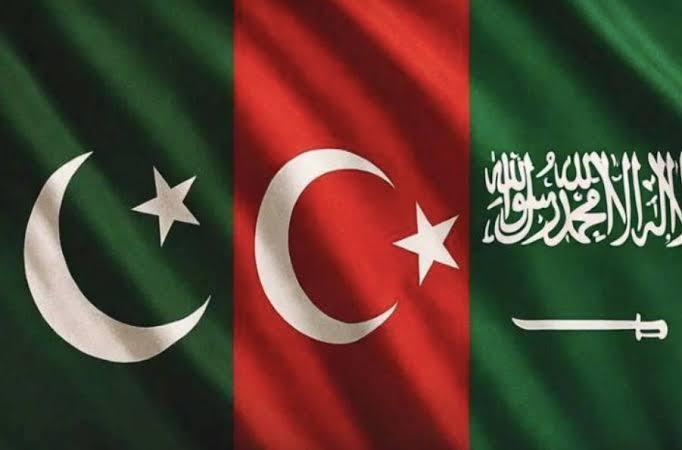
The newly formed Türkiye-Saudi Arabia-Pakistan bloc is a sign of the wider changing dynamics in global security: a shift towards middle powers attempting to create their own deterrence mechanism, as opposed to relying primarily on third-party guarantees. The new alliance is not a military alliance, but a pragmatic security platform, based on shared perceptions of threat, regional instability and strategic hedging.
Türkiye's, Saudi Arabia's, Pakistan's logic is simple. All three have different stresses placed on them, but all three desire more flexibility in their way of doing business in an age of shifting alliances and ever more "transactional" great power politics. Even though the triangle is not quite clear in its form, it is still important.[1]
A security triangle is formed
The idea of enhanced defense cooperation package between the three countries materialized as reports suggested in early 2026 Türkiye was mulling over joining the Saudi-Pakistan defense cooperation initiative. Earlier it had been mentioned that the capitals of Ankara, Riyadh, and Islamabad had discussions and defense cooperation which were trilateral in nature. All of these changes signal a transition from symbolic diplomacy to coordination of action on the part of the partnership.[2]
Not all it is said to be a pre-existing alliance, however. What's been taking shape is a more fluid set of defense understandings, joint interests and possible future commitments. But the flexibility is more significant than the text of the treaty in the current strategic context.[3]
The importance of timing
The reason for this is no accident. The confidence in outsourcing security has declined in the Middle East and South Asia countries. Regional powers have come to the conclusion that they need to diversify their defense options, enhance military-industrial partnerships and lessen their reliance on any one great power.
This is especially the case of Saudi Arabia. The United States, however, has long been the region's security protector, and a series of shocks has encouraged Riyadh to diversify its strategic partnerships. The country, on the other hand, has been playing the security role in the Muslim world for years and in recent years has been growing into its own defense industry and security role in the region. In this context, these trends converge and offer a distinctive chance for further alignment.[4]
Strategically, that is, the triangle is a product of necessity. It demonstrates a regional trend towards the creation of protection networks rather than waiting passively for outside assurances.
What each side can contribute
This relationship is complementary and attractive. Each state possesses resources that are needed by other states.
Türkiye's advantages include the military experience and interoperability with Western systems as well as the defense sector that is already established. It has one of the strongest defense sectors in the entire Muslim world, and is also developing a growing export industry, drone manufacturing and is known to be a very flexible operator. It offers a political instrument and a feasible one for Ankara in any security agreement.
Saudi Arabia supplies the capital, procurement skills and strategic know-how. Can fund common projects, enable industrial cooperation and offer political understanding with materialization. The importance of Riyadh is particularly highlighted in the modernist defense cooperation which is not only army and air force based but also is based on the cross of supply chains, funding and production capacity.
In the case of Pakistan, there is something else; the credibility of a traditional military; the experience of the military; the sanctum sanctorum of nuclear deterrence. Despite the fact that Pakistan's nuclear umbrella is not extended in any simple or automatic manner, strategic identity still has significance. For many in the region, Pakistan is the only country which has a credible deterrent posture at the top.
The triangle is popular due to this combination. Strengths in Türkiye, assets in Saudi Arabia, a sense of deterrence and military depth in Pakistan. It's a potent combination in an area where security has come to be seen as a portfolio and not a guarantee.
Why the label is misleading
Islamic NATO” is a slogan that has stuck with us but is a misleading one. The reason is that there is no common ideological project between the three States, there is no common threat, which NATO members knew what collective defense was, but there is a common interest. It is important because alliances can only be cohesive if they are around a clear strategic identity. In this case it can be interpreted as a hedging pact rather than a military pact because it is basically meant for protection against a future conflicts. Each member is trying to make himself as invulnerable as possible, new bargaining power, but is not making him so committed to a 'rigid bargain'.
For instance, Türkiye is a NATO member country and is unlikely to withdraw from its NATO membership. Saudi Arabia doesn't wish to alter all the existing partnerships. Similarly, Pakistan will have to deal with a tricky regional scenario with India, China and the Gulf and domestic boundaries. It is indeed a real triangle, but it is likely to remain more functional than dogmatic and forma.[5] So, a common identity is not enough for an alliance; an institutional mechanism, a common threat definition, and long-term political will are also needed.
Strategic benefits and risks
If this convergence is seen to increase its scope it could have a serious impact on regional security. For one thing, it would signal that the big powers of the Muslim world are no longer prepared to simply accept what is given to them. Secondly, it would further encourage cooperation in the defense field between the Middle East and South Asian countries. Third, it might make it more difficult for other states to calculate the impact of security competition, which has long been assumed to be a more or less disjointed struggle.
But there's a limit. The three states have different geographical locations, threat environment, and alliance commitments. Easy to say and hard to do! Building trust becomes easier during exercises, arms exchanges, intelligence sharing, logistics cooperation, and other exercises that highlight the same items, but can also be emphasized if certain items contradict. It will require institutions and not just headlines for the relationship to become more lasting.
The question also taps into the perception. The new security triangle may raise the alarm with the neighbours and invite big powers' sanctions.[6]
A new model of alignment
The significance of the Türkiye-Saudi Arabia-Pakistan deal is not what it means for the future of international order, it is simply more. States are being drawn to a system of non-uniform, more specific, and less formalized partnerships instead of being lured into a single fixed partnership. This is hardly the return of the bloc politics of the old Cold War. It's more malleable and more fractural.
From this perspective, the triangle is less about forming a Muslim military coalition, and more about building a security market. The States bring what they can: military power, finance, logistics, industrial capacity and deterrence value. It does not necessarily create a new super-alliance - rather, a tighter mesh of strategic interdependence. [7]
The deal is just interesting to watch. It's not a NATO style treaty, but it's an important redrawing of power balance in the wider Islamic world. The truth is that the label is not incorrect or accurate. It's the same assumption that all three countries (Türkiye, Saudi Arabia, and Pakistan) are following: autonomy needs to be constructed, not assumed, in a more uncertain world.
References
[1] https://www.dailysabah.com/business/defense/turkiye-pakistan-s-arabia-agree-to-enhance-defense-cooperation
[2] https://studies.aljazeera.net/en/analyses/emergence-regional-security-framework-türkiye-pakistan-saudi-arabia-and-egypt
[3] https://www.turkiyetoday.com/nation/turkiye-moves-toward-joining-saudi-arabia-pakistan-defense-agreement-report-3212673
[4] https://asia.nikkei.com/politics/defense/turkey-seeks-new-defense-platform-with-saudi-arabia-and-pakistan
[5] https://www.dailysabah.com/business/defense/turkiye-pakistan-s-arabia-agree-to-enhance-defense-cooperation
[6] https://www.forbes.com/sites/guneyyildiz/2026/01/11/turkey-saudipakistan-pact-and-the-security-market-thats-replacing-old-certainties/
[7] https://www.chathamhouse.org/2026/01/talk-turkish-military-alliance-saudi-arabia-and-pakistan-reflects-ankaras-opportunistic
Author: Dávid Biró, Senior Advisor, Research and Academic Network Lead of the Ludovika Center for Turkic Studies
Image source: encrypted-tbn0.gstatic.com