Hungarian Point of View on the Turkish War of Independence
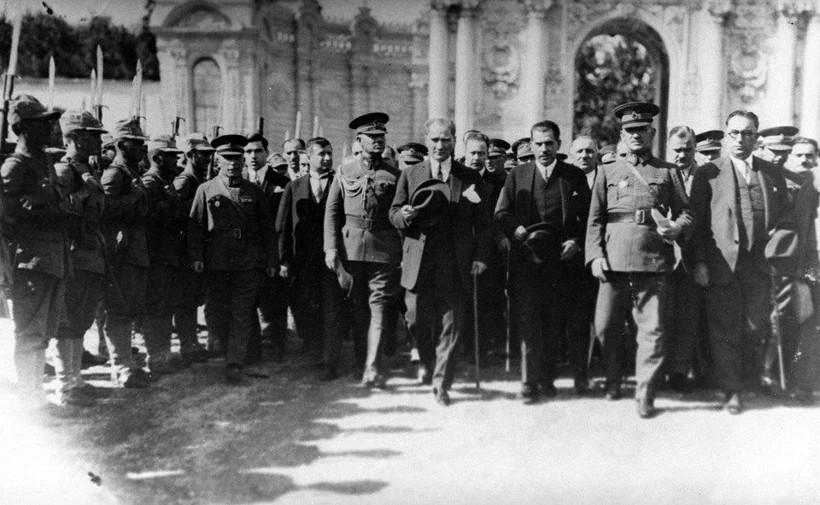
After the World War I ended, both the Hungarian Kingdom and the Ottoman Empire were forced to relinquish large parts of their historical territories. In 1920, with the failure to realise the borders envisaged by the Misak-ı Millî (National Pact), both Ankara and Istanbul understood that the empire would inevitably disintegrate. The Turkish National Movement, which opposed the Treaty of Sèvres, did not seek to preserve the empire, but rather to control the strategic regions where the majority of Turks lived. Therefore, the aim of the National Assembly was not to save the empire, but to establish a nation state.
The situation in Hungary was different. We must mention two important distinctions. The first is that, when the war ended, the soldiers who returned to Hungary wanted to continue their civil lives, because they were tired of war, not to mention that, there was serious social temper in some regions against the politicians who had led the country into war and against the government in general, and this situation was creating tension. It was in this atmosphere that the Chrysanthemum Revolution (Őszirózsás forradalom) emerged in Hungary in the autumn of 1918 and a new government was formed, the country gained back its full independency after hundreds of years. Still in autumn republic – a people's republic, in the terminology of the time – was proclaimed. István Tisza, the liberal conservative who had served as prime minister during the war and was a symbolic figure of the old system of the Austro-Hungarian Monarchy, was murdered in his own home by people whose identities remain unknown.
The government, with Count Károlyi Mihály as its new prime minister, faced a difficult legacy, as Austria-Hungary had also collapsed in November 1918. The historic Hungarian state was on the verge of collapse, and the government was struggling to maintain stability. After the communists seized power, the Allied Powers did not invite the Hungarian government to the peace conference in Versailles. However, the communists were successful against the foreign forces – which were considered occupiers – and recaptured important cities, particularly in the regions what is now parts of Slovakia.
Despite its military successes, the communist regime in Hungary ended after 133 days due to pressure from the Allied Forces and Hungarian right-wing, conservative groups. On 1 March 1920, Hungary became a kingdom again, and conservative forces came to power under the leadership of Admiral Horthy Miklós, forming every government until 1945. The main objective of Hungarian foreign policy was to revise the Treaty of Trianon, signed in 1920. Hungary was independent but remained a rather isolated country within the new order. One-third of the Hungarian population and two-thirds of Hungarian territory had been ceded to neighbouring countries. For contemporary thinkers and public opinion, this was unacceptable.
In such an environment, it should come as no surprise that the Turkish War of Independence also provoked a reaction among the Hungarians, because just as the Treaty of Sèvres meant for the Turks, so did the Treaty of Trianon mean for the Hungarians. Consequently, their antipathy towards Western Europe gained momentum. At the same time, the British, French and Italians initially opposed the War of Independence initiated by Mustafa Kemal. The Hungarian government's main objective at that time was to contact Mustafa Kemal and evaluate the possibility of changing the existing international status quo. Consequently, Budapest sent a secret agent named Jenő Ruszkay to Anatolia, thus laying the foundation for Turkish-Hungarian relations even before the republic was declared. Ruszkay paved the way for the cooperation later on between the Turkish and Hungarian government. At the same time, the Hungarian press was monitoring closely the Turkish War of Independence in 1920-1921 and on the diplomatic movements between the related countries, focusing on France, Greece and Great Britain. While the press was quite moderate and balanced, the government in Budapest tried to support the Turkish nationaist movement.
The first treaty of friendship signed between the Republic of Turkey and the Kingdom of Hungary on 18 December 1923 should be evaluated within this framework. That was the first international agreement signed and entered into force under the name of the Republic of Turkey, forming a very solid and sincere basis for the period that followed.
Author: Péter Kövecsi-Oláh, advisor - LCTS, LUPS
Image source: InternetHaber