Munich Security Conference: Why Security Discourse Can No Longer Disregard the Turkic States?
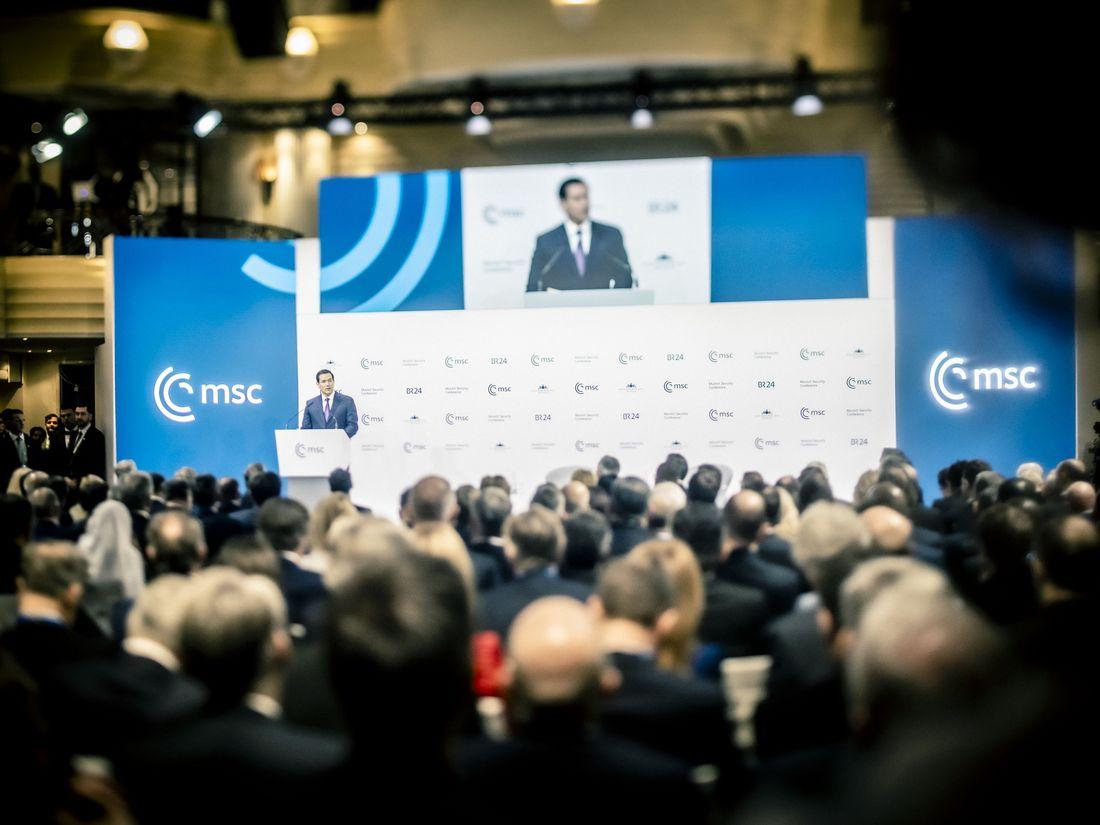
Munich Security Conference: Why Security Discourse Can No Longer Disregard the Turkic States?
Even the Munich Security Conference (MSC) identifies itself as the leading platform of global security discourse, it continues to consider the Turkic world as a passageway, rather than a player, in terms of strategy. This blind spot is no longer analytically benign at a time when the Organization of Turkic States (OTS) is quietly forging a new security axis between Istanbul and Almaty, the axis that is strategically consequential.
The transformation of cultural organization to security actor
The OTS has long been a scorned cultural club with big talk and small scope. The description is no longer appropriate. Since being institutionalised and rebranded, the OTS has expanded its groundwork and now includes security consultations, national security council meetings and a defence-industry coordination as a part of its principal agenda. During the last summits, rulers openly demanded increased collaboration in the area of defense industry and military cooperation, which is an indication of much more than folklore festivals. The Astana and Samarkand conferences turned out to be a qualitative breakthrough: security, defence acquisition and collaborative capability building became the main aspects of Turkic multilateralism. Although the new OTS Charter does not go as far as the mutual defence provision, its language on solidarity and collective action against threats has been likened with pre-Lisbon European Union language. That is to say, we have not here to do with a military alliance, but the institutional grammar of one. [1]
The security multiplier effect at Türkiye
The major multiplier in this change is Türkiye. Its military alliances with other Turkic countries go all the way to common trainings like Anatolian Eagle, regional exercises, training officers and defence academies, to combined drone and defence-industry programs. This ecosystem systematically diminishes the Russian historical monopoly in the military purchase of Central Asia and the South Caucasus and provides an alternative to a completely China-centered approach of connectivity. More importantly, it is not a top-down imperial design. The governments of Central Asia are practiced multi-vector foreign policy and have readily adopted the Turkish platforms precisely because of the capabilities that they provide without high political conditionality. The most brief perusal of recent studies will reveal, that Turkic cooperation has become so active that it can no longer be ignored that fact, which ought to reverberate in the chambers of the Bayerischer Hof.
The Middle Corridor is a security corridor
Should the MSC be committed to the connectivity, enforcement of sanctions and the future of the transport map of Eurasia, it cannot afford to make the Middle Corridor a technocratic logistics project. The line passing Central Asia via the Caspian, the South Caucasus and Türkiye to Europe is emerging as a security passageway defined by Turkic decisions regarding infrastructure, traditions and policing. Turkic states now occupy these competing visions; a Russia-centred Eurasian land bridge, a China-led Belt and Road, and an up-and-coming Turkic-European connectivity axis. Their method in tuning border security, digital infrastructures, and energy transit will affect all the way sanctions leakage to the eastern resilience of NATO. Discussing the concept of European strategic autonomy in Munich without the Turkic states is similar to discussing maritime security without inviting any coastal states. [2]
A threat to Russia and an insurance against China
The new role of the OTS in question is most apparent when the influence of Russia fades away. This weakness of the CSTO and the preoccupation of Moscow with Ukraine has created a vacuum that is being quickly filled with Turkic cooperation, aside the diversification of arms purchases to intelligence and police cooperation. It does not necessarily make the Turkic world a Western ally, but it does make a de facto hedge against both of the dangers Russian coercion and unbalanced Chinese dominance. In the view of Washington, a Türkiye-linked, more stable Central Asia that is less reliant upon Russian security assurances and less integrated into Chinese infrastructure is a positive but silent bonus. But this is a strategic advantage that infrequently appears in regular Western security debate, who continue to fall back on discussing Central Asia as pertaining to Moscow and Beijing as opposed to Ankara, Baku, or Astana.
What Munich needs to change
Should the MSC not wish to become an echo chamber of transatlantic apprehension, it ought to consider the Turkic states not as a side-panel curiosity, but as an irreplaceable co-authors to the extended security order in Europe. At least that implies three tangible changes. These are first the representation: leaders of OTS, national security advisers, and defence ministers must not only appear at regional breakouts but also at plenary debates on Ukraine, the Middle East, the Indo-Pacific, and governance of technology. Second, agenda design: the OTS and the Middle Corridor should receive special sessions, which will connect transport and energy to the defence-industrial cooperation, cyber security, and border management. Third, intellectual framing: analysts and reports to the feed-in of the MSC must cease to respond to the Turkic world as a passive space between powers and begin to analyse it as an organising principle to a new regional security architecture. The Munich security conference boasts of foreseeing the future security discussions. The shape of tomorrow Eurasian order will not be limited to Brussels, Washington, Moscow, and Beijing, but also to Ankara, Baku, Astana, Tashkent, and Bishkek. Any security discussion that does not consider the Turkic states has since become not only unfinished but also obsolete. Would you prefer this op-ed to be written in a more policy-analytical style, to appeal to readers who are expert readers, or in a more opinionated, magazine style, to reach a more general audience?
Due to the recent events in Iran, even closer collaboration with the Turkic world is even more strategically important. The lack of stability along the Iranian borders as well as the domestic political situation highlights the fact that some of the most important energy and transit routes are also very vulnerable, in the rest of the region. In that regard, a better aligned Turkic security and connectivity architecture will provide Europe and the transatlantic world with a second axis of resilience: a more diversified partnership in security, alternative energy and trade routes, and a range of actors not entirely aligned with Moscow, nor structurally reduced to Beijing or Tehran. Enhancing relations with the Turkic states is thus not a niche regionalist initiative, but a rational move to adjust to a changing geopolitical environment in which instability in and around Iran will at least assure Eurasian security over the next several years.
References
[1] https://www.cacianalyst.org/publications/analytical-articles/item/13913-central-asian-states-and-the-bagram-dilemma.html
[2] https://www.azernews.az/analysis/254432.html
Image source: securitiyconference.org

Author: Dávid Biró, Senior Advisor, Research and Academic Network Lead of the Ludovika Center for Turkic Studies