OTS Joint Statement on the Middle East and Regional Order
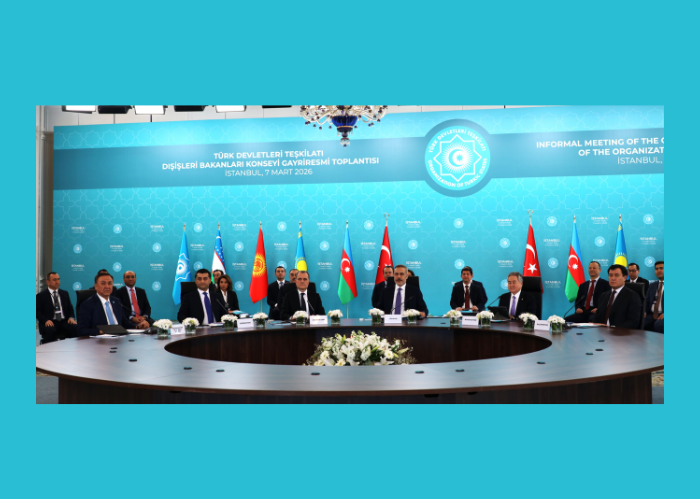
The recent Joint Statement adopted by the Council of Foreign Ministers of the Organization of Turkic States (OTS) in Istanbul on 7 March 2026 is more than a routine diplomatic communiqué. [1] It marks a subtle yet important transformation in the collective psyche of the Turkic world: from a diffuse cultural and linguistic community to an increasingly politicised group with a distinctive regional outlook, particularly on the Middle East. For those who study the nature of regionalism in Eurasia, this is an important symptom of how the Turkic world is starting to coalesce around security challenges, narratives and a sense of collective purpose beyond the former Soviet republics.
A united voice on the Middle East
The Istanbul Joint Statement is framed in terms of "recent developments in the Middle East", signalling that the Turkic world is no longer willing to be a silent spectator to the troubles on its immediate periphery. The ministers share concern over the escalation in armed conflicts, tensions and large‑scale humanitarian crises in the region, and condemn all acts that threaten innocent lives and stability. This is not simply an expression of solidarity; it is an effort to develop a joint Turkic‑led foreign policy on one of the hotspots of the 21st century.
The significance of this is that the statement positions challenges to Turkey and Azerbaijan as issues of concern for the whole group. They express their continued solidarity with Türkiye and Azerbaijan, and insist that a threat to their sovereignty and integrity is a matter of concern for all the Turkic states. Such rhetoric brings the OTS closer to the logic of a mutual‑defence alliance, albeit not an alliance per se. In a region where the workings of great‑power politics and proxy wars are the norm, this is a political statement that the Turkic‑speaking world is interested in being involved in discussions about Middle Eastern security orders. [2]
Sovereignty, non‑use of force, and the regional order
The Joint Statement includes a strong endorsement of the UN Charter and the principles of sovereignty, territorial integrity and non‑use of force. The ministers stress that stability in the Middle East is vital for the welfare and prosperity of the entire region and its people, therefore placing Turkic foreign policy in the context of a larger rules‑based discourse. This is no small consideration as it allows the OTS to play a pro‑stability role rather than being a disparate collection of states that had to be dragged into regional power struggles.
At the same time, the statement implicitly expresses a concern with external intervention. By arguing that regional issues need to be solved through political and diplomatic means, and by highlighting the role of regional actors in stabilising the region, the Turkic ministers are inching towards a more "regional‑ownership" approach to conflict resolution. This is not unlike the dynamics behind other regional groupings like the Gulf Cooperation Council or ASEAN, where states are trying to push back against great-power involvement. In the Turkic case, this encourages us to think of the Caucasus‑Central Asia neighbourhood as a separate regional sub‑system, rather than a mere transit route for global initiatives.[3]
From cultural ties to strategic coordination
The statement also stresses the need to intensify political consultations, institutional interaction, and take further steps towards deepening integration among Turkic states. The foreign ministers point out that the Middle East is but one of many global and regional issues, and they insist that coordination of efforts "on issues of common interest" should be deepened in accordance with the OTS's strategic plan. This is a small but important advancement: the statement presents the Turkic world not as an emotional fraternity of brothers, but as an inter-state area that needs to consult and coordinate its foreign‑policy moves.
For the Turkic project at large, this is a transition from rhetoric to concertation. The OTS already has an increasing institutional framework - summits, foreign‑ministers' councils, working group mechanisms - and the Istanbul statement affirms that these platforms are supposed to do more than simply issue statements: they are supposed to forge common positions, strengthen responses to crises, and build a strategic culture. This is particularly important for the middle‑size players such as Kazakhstan, Kyrgyzstan and Uzbekistan, which use regional bodies to gain influence and avoid over‑dependence on a single great‑power patron.[4]
The role of Türkiye and Azerbaijan
The Joint Statement clearly promotes the roles of Türkiye and Azerbaijan in the Turkic space. By explicitly reaffirming solidarity with both and emphasising that threats to their security are a concern for the whole organisation, the statement implicitly acknowledges that the centres of the Turkic political and geopolitical orbits are in Ankara and Baku. This is not to say that it is not inclusive, but it does mean that the heart of the emerging Turkic geopolitical space is in the South Caucasus and Anatolia.
This is a double-edged sword for other Turkic countries. It provides them with an opportunity to ride the foreign‑policy coattails of active players that already have extensive engagement with NATO, the EU, the Gulf states, and beyond. But it also brings up questions of autonomy and the danger of over‑deference to Turkish‑Azerbaijani primacy. The effectiveness of the OTS as a collective initiative will be determined by its ability to combine this core‑periphery dynamic with a genuine sharing of power and decision‑making.
Implications for the “Turkic world” narrative
At a more conceptual level, the Istanbul Joint Statement confirms that the Turkic world is turning into a political project with a regional outlook. No longer is it a question of language, history and culture; it is also about the capacity to align security views, reduce shared risks and define a collective position on major international issues. The OTS' take on the Middle East, a region in which it doesn't have direct security responsibilities, demonstrates that the Turkic states are starting to see themselves as a regional player with interests beyond their geographical space.
For others, this means that the Turkic space is not a frozen cultural entity but a dynamic region with multiple poles. Some view it through the lens of Turkish soft power, others through Central Asian sovereignty and independence, while others view it through the prism of energy and transit corridors. The Istanbul statement implies that all these are converging into a more coherent narrative: the Turkic world seeks recognition as a relevant, if not yet decisive, player in the Greater Eurasian and Middle East chessboard.
In any case, the OTS Joint Statement on the Middle East is brief but significant. It subtly marks the transition of the Turkic world into a more active stage of diplomacy, where the unity of identity is being supplemented with unity of action and a security outlook. It remains to be seen whether this will lead to a more stable regional order, or just a series of ad‑hoc arrangements, as to how the member states translate this momentum into institutional frameworks, coordination mechanisms and longer term policy coordination. But it is clear that the Turkic world is finding its voice and the world should take notice.
References
[1] https://www.turkicstates.org/u/joint-statement.pdf
[2]https://qazinform.com/news/turkic-states-agree-to-strengthen-dialogue-cooperation-42cfb6
[3]https://en.kabar.kg/news/fms-of-ots-member-states-adopt-joint-statement-in-istanbul/
[4]https://www.turkicstates.org/u/d/basic-documents/tenth-summit-declaration-2023-21-en.pdf
Author: Dávid Biró, Senior Advisor, Research and Academic Network Lead of the Ludovika Center for Turkic Studies
Image resource: turkicstates.org