Rethinking Collective Security in the Turkic World
Dávid Biró, Senior Advisor, Research and Academic Network Lead of the Ludovika Center for Turkic Studies
Dr. Serhat Süha Çubukçuoğlu, Senior Fellow in Strategic Studies and Director of Türkiye Office at TRENDS Research & Advisory, UAE
The security debate within the Turkic world has entered a qualitatively new phase. What began as a primarily cultural, linguistic, and economic cooperation framework has gradually acquired a strategic dimension driven by hard geopolitical realities. The Organization of Turkic States (OTS), while not conceived as a military alliance, is increasingly expected by its members—and watched by external powers—to contribute to regional stability, trade security, and strategic autonomy across Eurasia. This expectation reflects less an ideological ambition than a convergence of threat perceptions, connectivity priorities, and shifting power balances in the post-Ukraine war regional order.
The Eurasian Heartland
At the structural level, the Turkic world occupies one of the most contested geopolitical spaces in Eurasia: Halford Mackinder’s “Heartland”. Central Asia and the South Caucasus sit at the intersection of East–West and North–South trade routes, energy corridors, and digital infrastructure. They host critical commodities—including uranium, potash, gold, and strategic metals like antimony—that are essential to modern technologies and defense industries. As Azerbaijan’s full inclusion in Central Asian consultative mechanisms and trade initiatives illustrates, security and connectivity are no longer separable domains. The Middle Corridor, the Trans-Caspian route, and the Central Asian-C6 framework all depend on stable hinterlands, resilient borders, and secure maritime and air links. This reality has elevated security from a secondary issue within OTS deliberations to a level on par with cultural, economic, and eventually political integration.
Yet the OTS’s capacity to provide a collective security umbrella remains limited at this stage. Institutionally, it lacks a collective defense clause, common military doctrine, or integrated threat-assessment mechanism. Politically, member states exhibit distinct strategic cultures shaped by different historical experiences and threat priorities. Türkiye’s security outlook, for instance, is anchored in strategic autonomy, territorial integrity, and expeditionary defense capabilities, while Central Asian states remain primarily focused on regime stability, internal security, and risk avoidance vis-à-vis great powers. These divergences do not preclude cooperation, but they constrain how far and how fast it can be institutionalized.
External alignments further complicate the picture. Several Central Asian states continue to rely—formally or informally—on the Russian-led Collective Security Treaty Organization (CSTO), despite its declining credibility and operational effectiveness. For some others, membership in the CSTO does not preclude pragmatic security cooperation with NATO member states like Türkiye and Hungary so long as such engagement remains capacity-focused and framed around training, interoperability, and trade security rather than collective defense commitments. China, meanwhile, has emerged as the dominant geo-economic actor in the region, with growing but carefully calibrated security engagement linked to the protection of Belt and Road corridors rather than alliance commitments. The European Union, for its part, remains influential in regulatory, financial, and infrastructure domains but largely absent as a hard-security provider along Eurasian trade routes. This fragmented external environment reinforces the appeal of intra-Turkic cooperation while simultaneously limiting its strategic depth.
Defense Cooperation within the OTS
In this context, Türkiye–Azerbaijan defense cooperation has emerged as the most concrete security template within the Turkic world. Following the 2020 and 2023 Karabakh wars, bilateral cooperation—including access to NATO-grade security solutions—evolved into a deeply institutionalized partnership producing tangible military outcomes. Anchored in the 2021 Shusha Declaration and reinforced by the December 2025 memorandum recognizing an attack on one as an attack on both, this relationship now amounts to a de facto mutual defense cooperation agreement. The subsequent bilateral military-industrial collaboration demonstrated how political alignment, interoperability, and defense-industrial capacity can translate into tangible deterrence and battlefield effectiveness. Parallel cooperation with Pakistan, including the JF-17 Block III program and potential participation in Türkiye’s KAAN fifth-generation fighter project, points to the emergence of a multinational defense-industrial ecosystem. Importantly, this model has not gone unnoticed in Central Asia. Kazakhstan and Uzbekistan’s growing engagement with Türkiye in naval construction, UAV procurement, training, and defense-industrial cooperation reflects a pragmatic search for diversification [1].
The key strategic question is whether this bilateral template can be scaled up—incrementally—into a multilateral OTS framework. The answer is neither a simple yes or no. A NATO-style collective defense arrangement is neither politically feasible nor strategically desirable for most OTS members at this stage. However, a modular security architecture built around functional cooperation is both realistic and necessary. Joint military exercises, defense-industry coordination, intelligence sharing on terrorism and transnational threats, and the protection of critical infrastructure and trade corridors represent low-threshold entry points that respect political sensitivities while enhancing collective resilience.
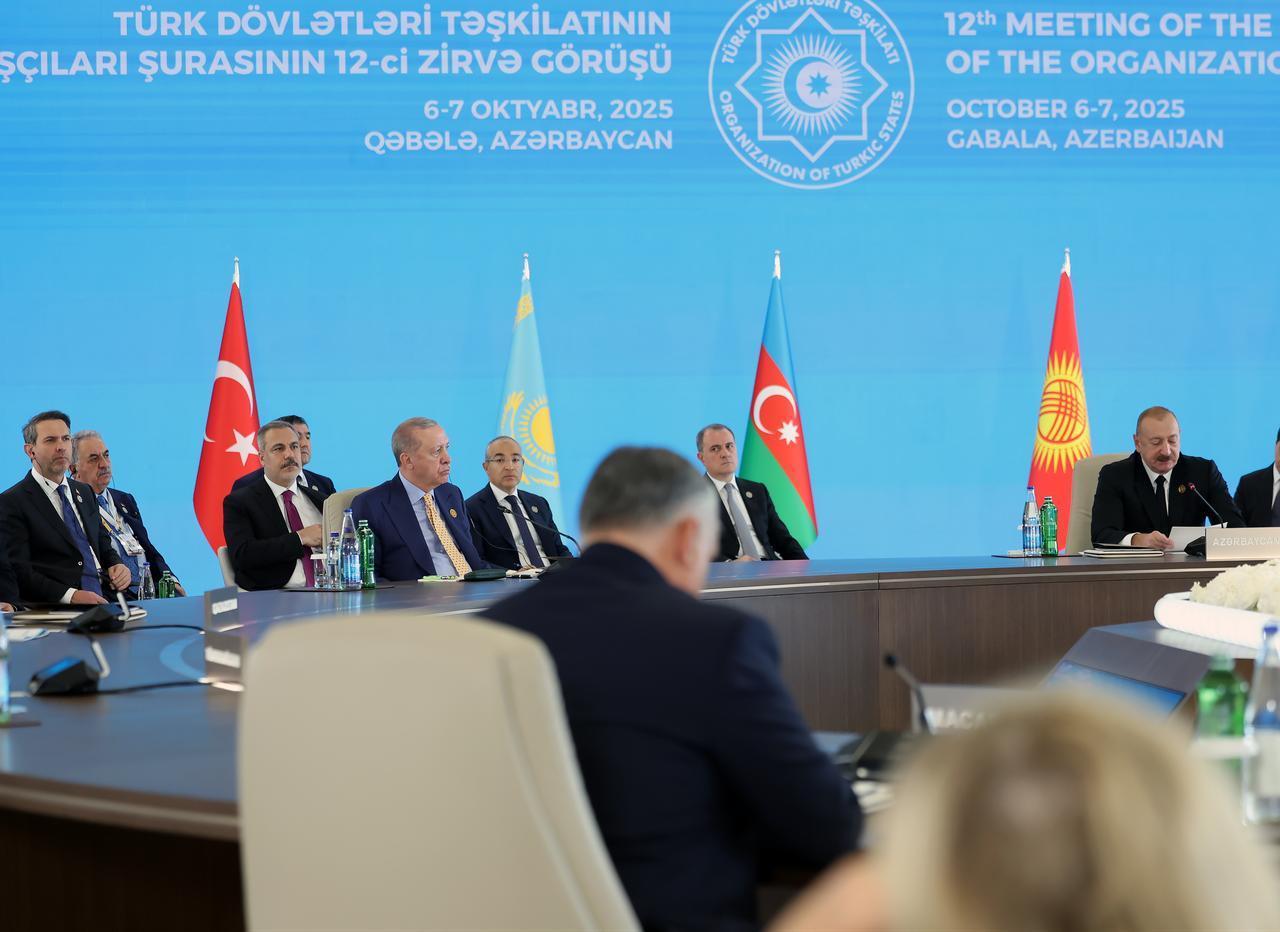
Recent developments point in this direction. The first meeting of OTS defense-industry institutions alongside IDEF 2025 in Istanbul, the language on defense-industrial cooperation, and explicit calls by Azerbaijani President Ilham Aliyev for joint exercises—while downplaying the notion of a formal military bloc—signal an emerging consensus on “security without alliance”. This approach reflects a broader trend among middle powers that seek strategic autonomy through flexible, capability-driven cooperation rather than binding alliance commitments.
Still, challenges remain substantial. Economic constraints limit defense integration, particularly for Central Asian states with modest budgets. Political caution persists due to concerns about Russian, Chinese, and Iranian reactions. Moreover, the absence of a shared strategic doctrine within the OTS risks reducing security cooperation to ad hoc projects rather than a coherent vision. Without a common threat assessment and prioritization framework, even well-intentioned initiatives may remain symbolic.
It is based on these mechanisms that a more ambitious structure is required that would entail three innovations: instituting a formal Defense Coordination Committee at the level of the defense minister that meets quarterly; initiating the integration of the defense industry under scheduled occasions of joint production and technology-sharing; as well as making multilateral military exercises more regularly, including friendly observer countries such as Hungary.
Turkish Military-Industrial Complex as a Stabilizer in the Region
The defense exports of Türkiye reached $8.5 billion USD in 2025, a dramatic expansion from $2 billion in 2020. [2] Turkish platforms, including Bayraktar TB2 drones, KAAN fighter jets and naval equipment, offer high tech equipment to the Central Asian states at affordable prices without any political strings attached by the West. Several decades ago, the choices of the Central Asia states were significantly narrow: either take Russian equipment and remain dependent on Cold War-era mentality or overcome the hurdles of the Western procurement. There has been a fundamental change in Turkish exports regarding this calculus. By offering good alternatives without entanglement in the Cold War-style of obligations, Turkish industry gives actual strategic freedom, which is required in the making of independent foreign policy. The Turkish defense cooperation is pragmatic in nature: Türkiye offers appropriate platforms on which recipient states have the liberty to exercise complete sovereignty of deployment.. The July 2025 OTS defense-industry summit nentrenches Turkish cooperation as some sort of auxiliary pressure that broadens the strategic choices of recipients and enhances the communal strength.
The Position of Hungary
Hungary is an example of the ways in which the European states can achieve Turkic security cooperation. As one of the OTS observers since 2018, and as the host to the first informal summit in May 2025, Budapest has demonstrated that she has a remarkable sense of Eurasian geopolitics. The fact that EU-NATO qualification of Hungary is combined with the Turkic relationship of the past provides a premise that is more than instrumental calculation. Hungary is a prospective route of receiving transnational technology and establishing defense-industrial relations. The capability to bridge is reflected in the model of defense agreement with Uzbekistan in April 2025 that would involve special attention to military training, transportation of technologies, and counter-terrorism.[3]
Furthermore, the OTS summit held in Budapest that made connectivity activities including the Middle Corridor, energy transit, and telecommunication in the limelight points to the fact that security and economic integration have a very close nexus. Hungary can also play a significant role in cyber-security co-operation. Cyber threats are within the scope of the priority concerns of the Budapest Declaration. The cooperation between the Hungarian Defense Innovation Research Institute (VIKI) and the Turkish TÜBITAK is an institutional tool to boost this cooperation.[4] With escalating cyber threats against the energy and military infrastructure, a harmonized cyber-defense framework that integrates NATO standards and threat evaluations of the Turkic states would increase the overall resilience of the unanimous effort. The position of the Hungary embassy in Tashkent as a NATO liaison office provides an institutional avenue through which NATO worldviews could be used to shape the OTS security discourse. This sensitive role serves the fact that some of the members of the OTS have deeper security ties with Russia in the CSTO. Hungary’s moderated role is capable of providing the balance of the regional security status quo, serving the interests of the Turkic population as well as the Euro-Atlantic alliance.
Addressing Structural Vulnerabilities
A good structure is one that addresses vulnerabilities. One of the greatest constraints remains on the economic front: procurement facilities in Central Asia are stuck because of budgetary limitations. Thus a stimulating structure must have new financing facilities– A functional framework requires creative financing mechanisms—joint procurement consortiums, preferential lending, and technology transfer agreements substituting knowledge for capital expenditure. Second, different relations with foreign countries create challenges. Both Kazakhstan and Kyrgyzstan are members of the CSTO and the SCO (Shanghai Cooperation Organization). These duties ought not to be replicated but instead adjusted to some form of a Turkic structure by way of careful diplomatic construing that emphasizes on the fostering of independence Third, collective defense is hindered by border issues and unresolved territorial claims (e.g., relations between Armenia and Azerbaijan, Kyrgyzstan and Tajikistan). These frictions should be paid attendion to directly by employing confidence-building and dispute-resolution procedures.
Conclusion
Both vulnerabilities and opportunities occur alongside geopolitical rebalancing since the preoccupation of Russia with Ukraine, growing influence of China, and a new revival of the interest among the West to Central Asia. The bilateral agreement between Azerbaijan and Türkiye shows that successful collaboration is a possibility with real returns. The multilateral cooperation is facilitated by the structures of the OTS such as diplomatic channels, institutional, and summit declarations. With the help of a conscious institutional innovation, practical cooperation within the sphere of defense industry and strong adherence to the principles of collective security, the Turkic world can create a system that meets the security needs of its participants, and at the same time, help enhance Eurasian stability.
References
[2] https://www.dailysabah.com/opinion/op-ed/turkiyes-defense-industry-soars-85b-in-exports-in-2025.