The Caspian Bottleneck: Why Cross-Caspian Projects Stall and What Could Unlock Them?
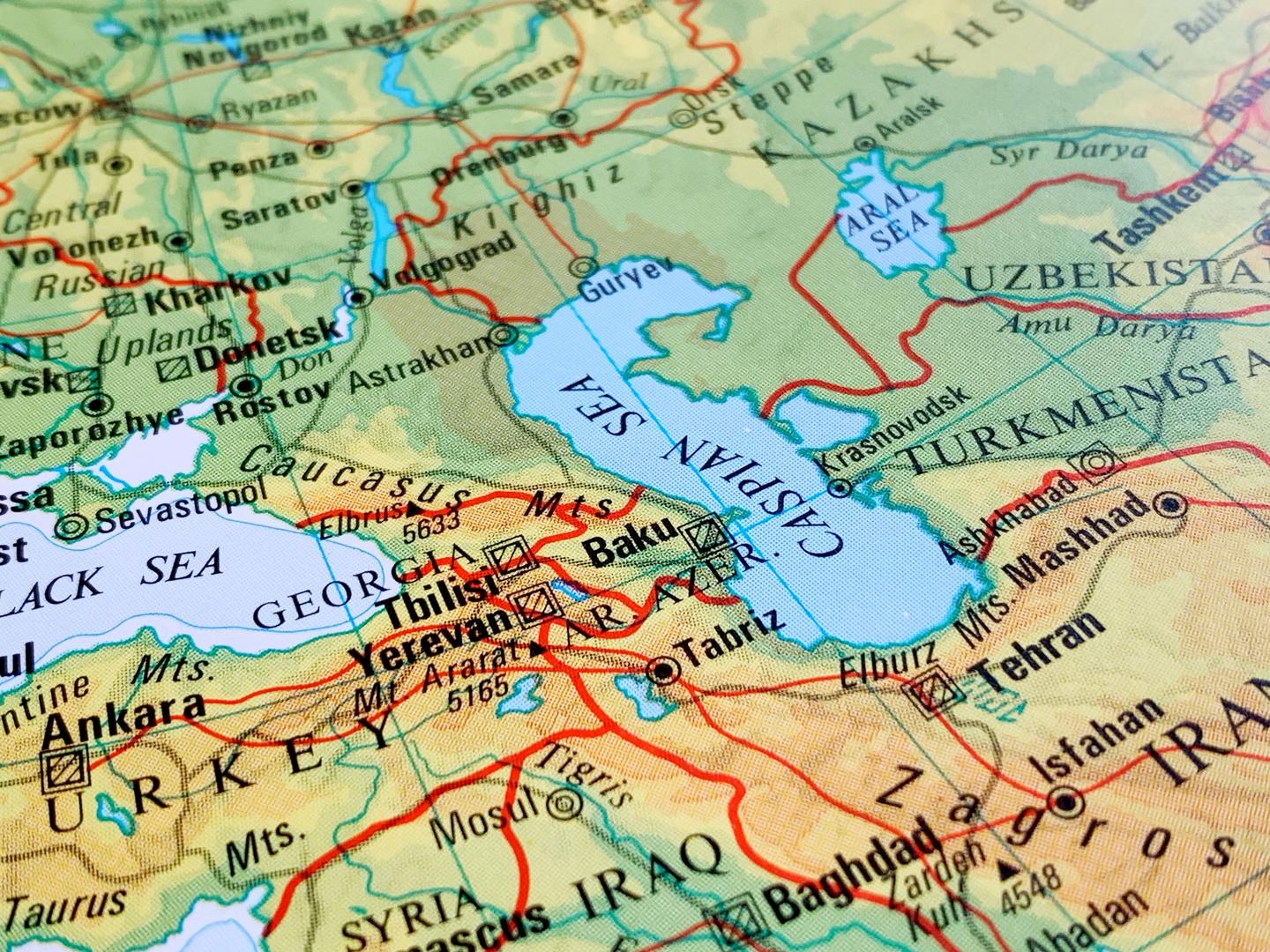
The Caspian Sea, just like on the map, sits at the center of Eurasia’s connectivity ambitions, yet it is more likely a valve rather than a bridge. Since the collapse of the Soviet Union, the region’s energy and transport map has been redrawn by new borders, new regulations, and competing strategic interests. New actors emerged on the scene, including a stronger presence of China, the Gulf countries, Europe and obviously, the United States. However, Russia’s influence in the Caspian and Central Asia may have declined from what was experienced in the Soviet-era, it is still a key player and a decisive actor, especially in the energy sector. At the same time, Western and Gulf companies expanded their presence in oil, gas, and clean energy, adding investment power, competition, and increasing tension to an already sensitive space. It is therefore clear that large investments require further investments, typically in the field of transport infrastructure development.
It must be stated that in the last couple of decades, Cross-Caspian cooperation was all about ideas and a vast of potential and the buzzword, “Cross-Caspian” is now covering a continuously growing portfolio of initiatives. It includes trade and transport connectivity in the spirit of the Middle Corridor logic, a strategic multimodal route, with port upgrades, rail interfaces, and maritime capacity to move goods across the sea and on land through the South Caucasus and Türkiye toward Europe. It also includes a North–South logistics concept, in what the Caspian is a part of a route connecting Russia and Central Asia to Iran and, through Iranian ports, to South Asia. Beyond these logistics concepts, there are energy-related linkages: pipelines, electricity trade and also infrastructure concepts that can deepen interdependence without pushing all parties into a single vulnerability. But the cooperation however, regardless of the potential, lacks predictability at the one point you cannot bypass: the sea itself.
There is one initiative that appears to be the biggest challenge and the textbook case of all Trans-Caspian projects: a subsea gas link, the Trans-Caspian pipeline concept. Though this is just one cross-Caspian project, with all its burdens and hardships, it can undeniably showcase why so many initiatives stall. This project’s significance lies in the seabed. 2021 figures from Russia’s Ministry of Natural Resources put proven hydrocarbons in the Caspian shelf at roughly 2.95 billion tons of oil and 3.1 trillion cubic meters of natural gas. Despite the fact that the subsea pipeline would have easily quantifiable benefits, it also concentrates the hardest issues – legal interpretation, environmental claims, investor confidence, and projection of force – which hinder other trans-Caspian projects as well. If the gas pipeline project were to be successfully implemented, it would set an example and give a serious boost to regional developments for a long time. In reality, legal ambiguity becomes political leverage. Even if a project is technically feasible, uncertainty around the durability of procedures, permits, and regulations increases transaction costs, slows down permitting, and encourages “wait-and-see” attitude among investors.
The reasons the subsea gas pipeline project is stalled are not mysterious. First of all, the Caspian’s legal status has been debated for decades, and while the 2018 Convention on the Legal Status of the Caspian Sea reduced some uncertainty by establishing a special legal status, it did not eliminate disputes over border demarcation and the conditions for the construction of subsea infrastructure.
It is very important to note that in the case of the pipeline Iran remains a key variable in the uncertainty. Tehran’s unwillingness to ratify the 2018 convention – linked to disputes over surface division, broader delimitation and of course for its own commercial and economic interests – reinforces the sense that rules are inferior to various political interests. Even where projects do not formally require consensus, political realities can make the impression as if the veto is a tool that can be used at any time – and this assumption alone is often enough to restrain ambitions.
Energy infrastructure, moreover, has never been purely economic consideration in this region. Russia’s strategic attitude for instance, has been to remain central to regional energy flows on the long run – both for influence and for managing its own supply commitments and domestic demand. Western investment after 1991 however brought capital and technology, but it also intensified geopolitical competition around access, routes, and control. In this environment, the decision is not whether a project is feasible, but whether it is strategically acceptable. The basic logic is simple: if a cross-Caspian connection is seen as shifting the balance of power too quickly compared to how quickly political relations can adapt, it will encounter resistance, delay, or quiet obstruction – often without a clear “no”.
Then there is bankability. Large infrastructure needs stable rules, predictable permitting, and confidence that contracts will be respected across political cycles. The experience of the pipeline is a warning sign: even estimated success stories can take much longer than planned because the ownership structure is complicated, financing is difficult to coordinate, and obtaining permits can take years. The Caspian Pipeline Consortium (CPC) illustrates this dynamic well. The pipeline is strategically important forexporters, but its expansion history shows how heterogeneous ownership, financing complexity, and renegotiations can stretch timelines and inflate costs.
Operational constraints add another layer that tends to be underestimated. Cross-Caspian movement depends on ports, vessels, loading systems, customs procedures, and scheduling discipline, many of which do not scale smoothly. You can build rail on both shores and still lose time and money at the maritime interface if capacity, coordination, or procedures lag behind. These are not headline-grabbing problems, but when combined, they create business uncertainty – and that is what makes carriers and financiers more cautious.
Finally, the environmental dimension is no longer a side issue. The Caspian ecosystem has become an explicit policy concern for coastal states, with climate stress and the footprint of extraction and transport increasingly tied to regional security narratives. For investors, this means stricter scrutiny, reputational considerations, and the need for clearer guarantees – especially for seabed projects. This does not necessarily result in general rejection, but rather in higher due-diligence and a longer decision-making process.
All of these constraints are visible in the Trans-Caspian pipeline debate. The concept is straightforward: connect Turkmen gas to Azerbaijan across the seabed, then feed existing westward infrastructure toward Türkiye and Europe. In practice, a subsea line is the riskiest form: it is particularly affected by the controversial legal issues related to the seabed, it is geopolitically sensitive because it can rearrange the balance of power, and it is financially difficult because it requires long-term commitment. This is why “workarounds” remain on the agenda; LNG transport and other delivery arrangements can move volumes without crossing the same legal and political threshold as a fixed subsea pipeline. They are not as cheap and do not provide as much capacity as a pipeline, but they maintain room for maneuver and gradually build trust, thus reducing the perception of risk.
If we consider the Caspian a bottleneck, the way forward is less about one dramatic breakthrough and more about a reform in the guidance and cross-governmental cooperation. What unlocks cross-Caspian projects is undoubtedly increased predictability, meaning clearer procedures for permitting and environmental assessment, tighter mechanisms for managing disputes, and an emphasis on operational upgrades, depending on the type of the project. Just as importantly, projects require separating political symbolism from operational delivery. Cross-Caspian cooperation needs quiet alignment between ministries, regulators, investors, port authorities, and operators, because reliability is built by systems, not announcements.
In the end, a conclusion must be drawn: these cross-Caspian projects stall because a wide package of uncertainties; law, geopolitical dynamics, operational and administrative burdens, financial issues, and ecological considerations. Until the parties won’t reach mutual ground, there won’t be any progress, not to mention success – which, I believe would be a mutual benefit for all. A shift from ambition to manageability is well needed. The Caspian does not need to become frictionless to become strategic. It only needs to become manageable.
References:
(1) https://rg.ru/2018/09/18/reg-ufo/skolko-na-kaspii-imeetsia-zapasov-nefti-i-gaza.html
(2) https://www.gov.kz/memleket/entities/mfa/press/article/details/591?lang=en
(3) https://www.cpc.ru/RU/about/Pages/shareholders.aspx
https://tass.com/politics/2059073?utm
Author: Blanka Benkő-Kovács, advisor - LCTS, LUPS