The importance of the modern Hejaz Railway
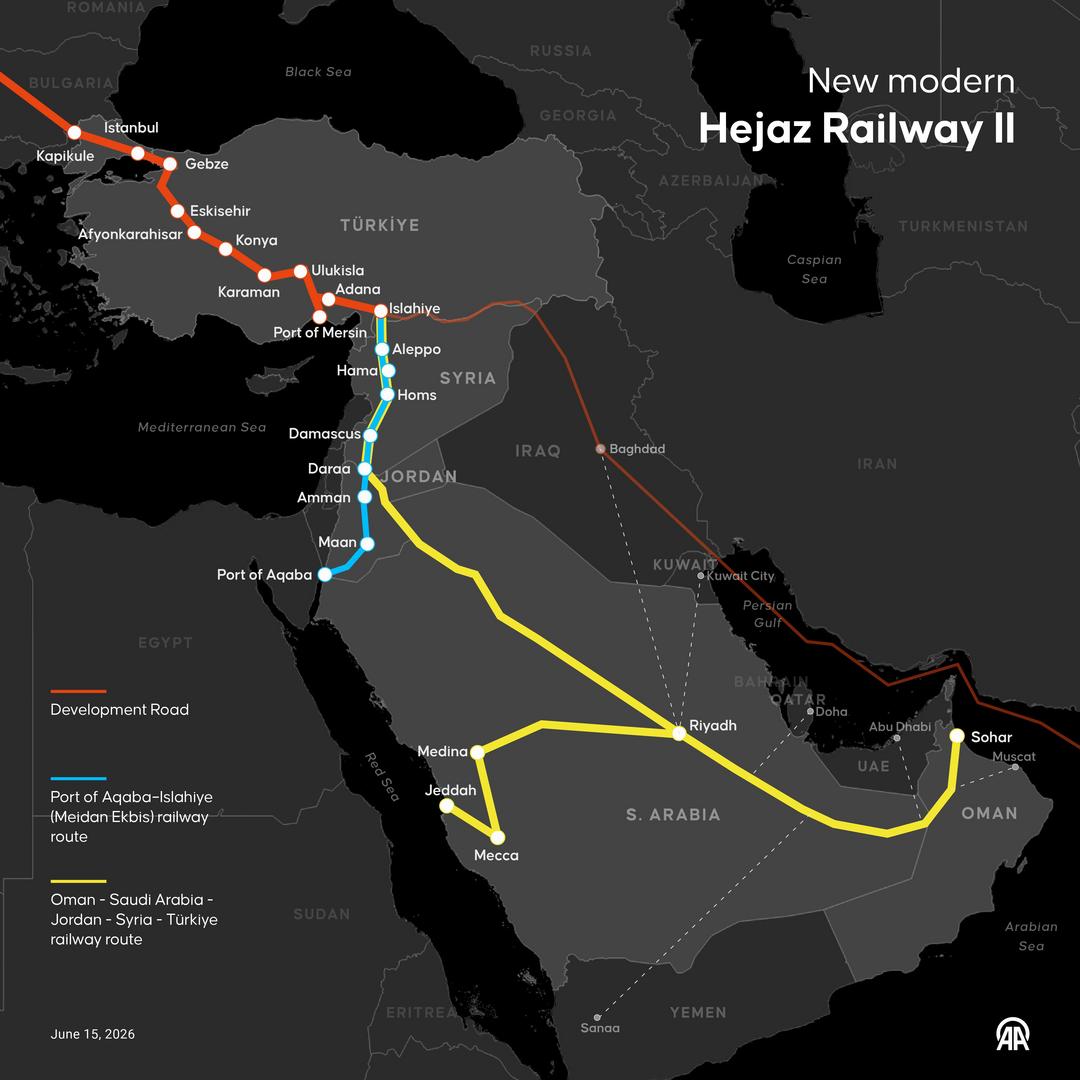
The importance of the modern Hejaz Railway
The Hejaz Railway revival is more than just an infrastructural story. Rail lines, logistics corridors, and digital connectivity are now as important as borders, alliances, and military deterrence. The project is a geopolitical marker of the new Middle East.
At first glance the project is the story of tracks and stations. In fact, it's all about strategic autonomy. Perhaps more important in an area where key transport routes such as those across the Red Sea and the eastern Mediterranean. [1]
The Historical Legacy
The original Hejaz Railway was one of the most important of the Ottoman enterprises, that bound together the Arabian Peninsula more closely with the Ottoman Empire and strengthened political, administrative and religious connections in a wide and scattered land under control of a sultan. It was not only a piece of engineering, it was a weapon of state craft.
That's why it was opposed. The line had always been seen as a potential threat to imperial rivalry in terms of trade, influence and control access to the Arab provinces and was also embroiled in the wider conflict between Ottoman rule and European strategic interests. For that reason and for the fact that it reveals the political nature of transport infrastructure in the Middle East throughout the ages. [2]
The Project Returns Now
The era of connectivity is challenged and the modern revival comes at a timely moment. The world still has a small number of very vulnerable ways to move energy, goods and data: from the Gaza war to the tensions with Iran, from the unrest in Syria to the uncertainty of maritime routes, there is a fundamental set of challenges.
However, that is not only what is being talked about as a symbol for heritage projects, but also as a part of the Resilience Architecture, the Hejaz Railway, it would be linked with Aleppo and would take advantage of the existing Aleppo – Damascus – Jordan network, and the negotiation with Saudi Arabia on the longer term network are also important. This is crucial, because the limited connectivity may help ease the strain on the already congested sea lines and enable a more flexible regional logistic network. [3]
States and companies are increasingly looking at disruption-resistant routes, in a world of disruptions and shocks. A railway can, however, diversify trade flows and promote the overland trade and reduce dependence on one maritime route, rather than replace Hormuz.
Geopolitics of Redundancy
The reason behind the modern Hejaz Railway is to diversify the routes. The project is also part of the broader connectivity project for Türkiye, which includes the Development Road through Iraq and the Middle Corridor, which links Central Asia and Europe. These corridors collectively imply a conscious strategy to place Türkiye in the liminal space of the intersection of regional networks.
It's no small goal. In Eurasia in addition to freight revenues transit host countries have leverage. Their impact extends to supply chains, energy security, industrial planning and even diplomatic alignment. In this regard the Hejaz Railway is not just a railway, but an effort to rewire regional dependence. [4]
That's also a more political message. This is a sign that the Saudi-Turkish ties are not just transactional. Ankara and Riyadh are probing to see if they can build a longer-lasting regional order through infrastructure, as opposed to summits or crisis management, by travelling down the rail corridor that stretches from Syria to Jordan and further on to the Gulf coast.
Beyond Oil and Steel
The modern Hejaz Railway is popularly called a trade corridor but it is much more. The new report talks about a fiber-optic land-based path as the reality of connectivity today, as goods, energy and data are all competing for strategic space. This is an important factor to consider!
Today, a corridor is not only used for transporting containers or petroleum, but it also serves other purposes. It's useful because it can be used for the digital economy infrastructure. By having reliable land-based physical and digital routes, states with these routes can be more resilient to disruption, sabotage, and geopolitical coercion in the maritime domain. In this respect the modern Hejaz Railway is a new type of project, that of insurance for connectivity. [5]
That is also the reason for the competing interpretations of the project. Others perceive it as a handy answer to the chaos in the region and threat in Hormuz. Others see it as a struggle for influence in the regional transit system in Israel. Both reading passages give only a small part of the picture. The railway is at the same time an economic initiative, a geopolitical insurance policy and a declaration as to who will draw the lines on the future map of exchange in Eurasia.
A space that is closed off and limits access
The barriers should also be considered as a serious factor in a proper assessment. Syria remains a delicate political climate, reconstruction is highly expensive, and funding is also unclear; coordinating the movement of goods by rail will require legal, security and customs arrangements, which can't be improvised. It is not a construction project, it's a memorandum project .
This is often the beginning of infrastructure diplomacy, however. The important thing about a corridor, is not that it is simply built, it is that the corridor forms a common basis of expectation. It provides an incentive for governments, companies and lenders to think outside the crisis. The political act of accepting a course on action is a narrowing of the gap, between aspiration and institution, even if the railway itself should come along slowly. [6]
Conclusion
The modern Hejaz Railway is significant in the context of a larger change in the geopolitics of the Middle East. The battle for power is more about who can dominate the trade, energy and data pipelines than about armies and alliances and ideology. Thus, the railway could be seen as a strategic solution to fragility: a solution to make vulnerability into connectivity.
It's the historical forebear that united an empire. It is not its primary function these days, but it might be able to tie together a more solid regional arrangement. If successful, then the Hejaz Railway will no longer be a relic of an old railway line. It will revolutionize the geopolitical way of considering the Middle East.
References
[1] https://www.dailysabah.com/opinion/op-ed/turkiye-saudi-arabia-axis-hejaz-railway-rewiring-eurasian-connectivity
[2] https://www.fdd.org/analysis/2026/06/15/turkeys-hejaz-railway-revival-is-a-bid-to-undermine-israels-regional-role/
[3] https://www.dailysabah.com/opinion/op-ed/turkiye-saudi-arabia-axis-hejaz-railway-rewiring-eurasian-connectivity
[4] https://www.aa.com.tr/en/turkiye/modern-hejaz-railway-to-create-alternative-route-to-hormuz-turkish-transport-minister-says/3955118
[5]https://researchcentre.trtworld.com/publications/analysis/the-hejaz-railway-and-the-new-silk-route-of-the-middle-east/
Author: Dávid Biró, Senior Advisor, Research and Academic Network Lead of the Ludovika Center for Turkic Studies
Image source: reddit.com