The legacy of Lajos Ligeti
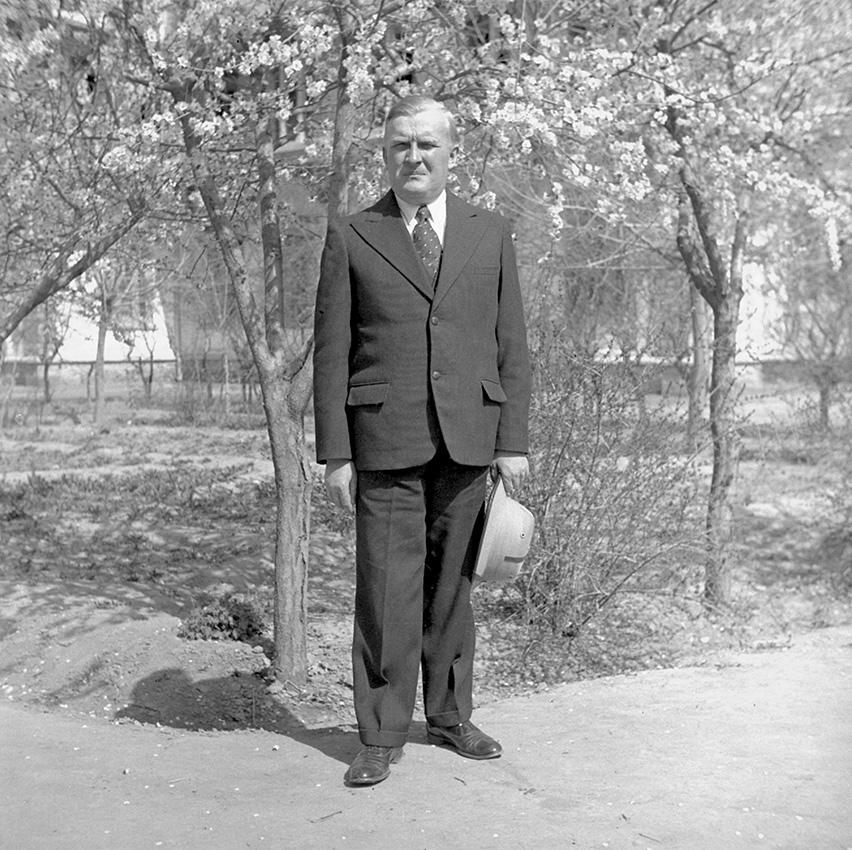
“The results (or lack there of it) of our efforts can only be measured after a longer period of time.”
Lajos Ligeti (1902–1987) was a Hungarian orientalist and one of the most prominent and influential figures in 20th-century Eastern studies. He was a Turkologist, Mongolist, Manchu-Tungusist, Tibetologist, and Sinologist at the same time. After studying in Budapest and Paris with well known French orientalists of the era, he undertook extended research trips to Inner Mongolia, Afghanistan, and Japan. From 1949, he was appointed as vice president of the Hungarian Academy of Sciences for two decades, and from 1964 to 1971, among his many other positions, he headed the Department of Turkish Philology.
In the summer of 1949, he was a member of the four-person committee that established the Oriental Collections of the Library and Information Centre of the Hungarian Academy of Sciences, which he enriched with part of his own Mongolian-Manchu collection. The library's holdings include, among other things, the estate of Sándor Kőrösi Csoma (1784–1842) and the Hebrew collection of Dávid Kaufmann (1852–1899). However, the richest manuscript collection is, understandably from the perspective of Hungarian history, related to the Ottoman past. Dániel Szilágyi (1831–1885) played a major role in its creation, as he owned ans provided countless publications through his bookshop in Istanbul. The Oriental Collection also includes publications from the Istanbul printing house of a Hungarian born Ibrahim Müteferrika (1674–1747), who was born in Kolozsvár (Cluj-Napoca, Romania), and is known as the founder of Ottoman printing. With Ligeti's help, the Oriental book collections of the Balkan Institute operating within the University of Kolozsvár, the Kiskunhalas Gymnasium, and the Metropolitan Library were brought to Budapest.
In addition to publications in Ottoman Turkish and related topics, the library's collection was significantly expanded by the 11,000-volume estate of Sándor Kégl (1862–1920), a teacher of Persian language and literature.
Returning to Liget: although in 1974 he decided to donate his private library to the library of the institution formerly named after Attila József, now known as the University of Szeged. Four years later, he left his scientific notes, sketches, some of his manuscripts, and unprocessed materials to the Academy Library (specifically designated as the Oriental Collections of the Library and Information Centre of the Hungarian Academy of Sciences – LHAS). This collection of documents was supplemented by his own selection of official, but not scientific, correspondence, which he also bequeathed to the academy before his death.
Focusing on Ligeti's work in Turkology, we must highlight his researches on Turkic loan words in Hungarian language before the conquest of the Carpathian Basin and during the period of Árpád-dynasty, plus Oghuz Turkish dialectology. During his research trip to Afghanistan (1936–37), he thoroughly examined the linguistic development of the Mongolian ethnic group in the Herat region and the language of the Turkish (Uzbek) groups in Afghanistan.
From a scientific history perspective, it is interesting to note that political considerations may have played a role in the rise of Ligeti's scientific career after 1945, as the Hungarian scientist did not leave Hungary either after the Great Depression or after the German tropps occupied the country (1944). After returning home in 1931, he taught at the University of Budapest for three years without any financial support. Although his connections in Paris enabled him to teach as a visiting lecturer in the French capital, he ultimately decided to stay in his homeland in 1934 and remained in Budapest instead of accepting the offer from the French university. In 1944, following the German occupation, his adherence to his scientific principles provoked the disapproval of the ruling far-right regime.
Ligeti's work shows that consistent service to science is not always a rewarding or safe undertaking, but only that can serve as a stable basis for the future.
Sources:
Rottár Máté: Ligeti Lajos hagyatéka az MTA Könyvtár és Információs Központ Keleti Gyűjteményében. In: Keletkutatás, 2022. ősz, pp. 21–43.,
Rottár Máté, Kelecsényi Ágnes: Sárga istenek és ritka nyelvek nyomában. Ligeti Lajos (1902–1987), az iskolateremtő tudós. Budapest, MTA Könyvtár és Információs Központ, 2022. ISBN: 9789637451829)
Author: Péter Kövecsi-Oláh, advisor - LCTS, LUPS
Image source: https://orient-projekt.hu/eletrajzi-adatlapok/ligeti-lajos