The Turkic States at the UN: Toward a More Coordinated Geopolitical Voice
The Turkic States at the UN: Toward a More Coordinated Geopolitical Voice
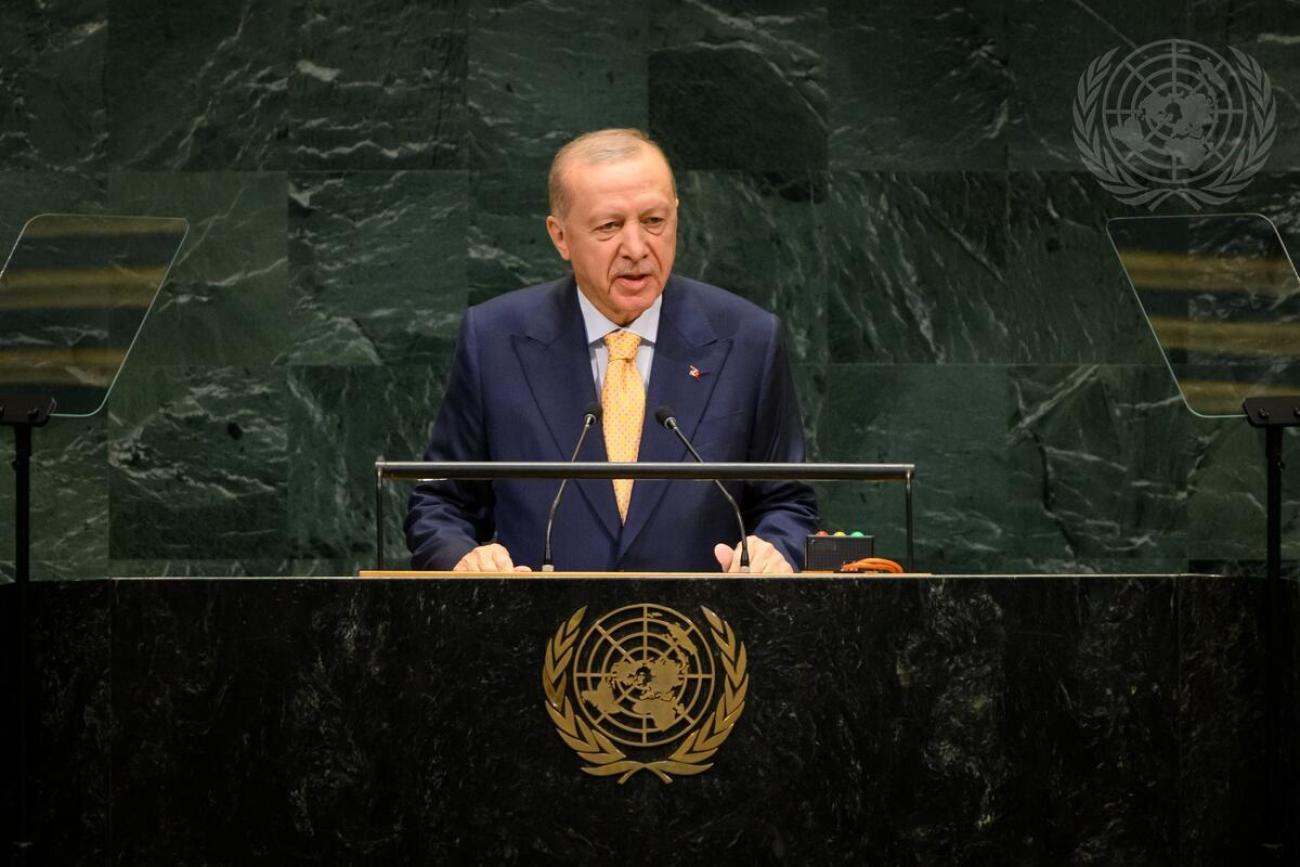
Türkiye delivered the most explicitly political and strategically framed message among the five states. President Recep Tayyip Erdoğan put Gaza and Palestinian statehood at the heart of his speech, meanwhile claiming that the UN has lost the ability to “fulfill its primary responsibility of international peace and security.” Again he upends the world as the Security Council stands, with his now familiar axiom “the world is bigger than five.” Erdoğan also expressed his support for a lasting peace agreement between Azerbaijan and Armenia, and described the OTS as an exemplary model of regional cooperation ahead of the 13th summit to be held in Ankara on 30 October. Erdoğan also reiterated his call for the recognition of the sovereign equality and equal international status of the Turkish Cypriot people and urged the international community to establish political, diplomatic and economic relations with the TRNC. The appeal also carried an OTS dimension, as the TRNC participates in the organization as an observer. [1]
Azerbaijan linked the reform of multilateral institutions to the political transformation of the South Caucasus. Foreign Minister Jeyhun Bayramov said Azerbaijan and Armenia had achieved “de facto peace” and had opted to forget about the hostility. The fact that Azerbaijan is placing particular emphasis on the Middle Corridor – including the Baku–Tbilisi–Kars railway line – and on new links through the South Caucasus suggests that Baku regards peace as the foundation of a broader Eurasian transport system. [2]
Kazakhstan remained in its position as a middle power with multivector foreign policy and bridges between the world powers. Foreign Minister Mukhtar Tileuberdi warned of a global ‘trust deficit’, advocated diplomatic solutions to the conflicts in Ukraine and the Middle East, and reaffirmed Kazakhstan’s support for a two-state solution to the Israeli–Palestinian conflict. Kazakhstan also advocated for nuclear disarmament, biological security, water diplomacy and more representation for Asia, Africa, Latin America, developing and middle powers on the Security Council. [3]
Uzbekistan’s message centred on openness, human dignity and regional transformation. Saida Mirziyoyeva, Head of the Presidential Administration of Uzbekista, agreed with the necessity of increasing the size of the Security Council and pointed out that the international rules should be applied in the same way, and not according to the interests of the powerful countries. She portrayed Central Asia’s movement away from border and water disputes towards cooperation as an example of successful regional ownership. Her calls for constructive cooperation with Afghanistan, as well as for attention to be paid to the Aral Sea, artificial intelligence and domestic reforms, linked security with sustainable development. [4]
President Sadyr Japarov of Kyrgyzstan looked at multilateral reform from a smaller, landlocked and mountainous country's point of view. He proposed setting up a public register to keep track of the implementation of UN decisions and condemned any sanctions not taken under the auspices of the UN. Japarov also highlighted Kyrgyzstan’s election to its first-ever term as a non-permanent member of the Security Council for 2027–2028. [5]
Outside the General Assembly chamber the best clue to a common Turkic stance was found. During the informal meeting chaired by Azerbaijan, OTS foreign ministers talked about the preparation of the Ankara summit, transport, energy, trade, digitalisation, etc. Most importantly, they agreed that the acquisition of UN General Assembly observer status of the OTS is a common strategic goal. This would give the organisation an institutional voice in the UN system and enhance its capacity to harmonise its positions with other international actors.
It is not enough to say so lightly that these developments do not matter that much – they differ in their relations with Russia, China, Europe and the United States. However, UNGA 81 showed that the OTS was going beyond the cultural symbolism. Its members are increasingly using diplomatic language that raises issues such as sovereignty, regional solutions, institutional reforms and intercontinental links. They are not building a monolithic front, but a flexible platform that strategically placed middle and smaller powers can leverage to lend their voices – and perhaps to change the political and economic map of Eurasia. [6]
References
[1]https://turkiye.un.org/en/323157-president-erdoğan-addresses-un-general-assembly-and-meets-secretary-general-guterres
[2]https://www.azernews.az/nation/264501.html
[3]https://webtv.un.org/en/asset/k1x/k1xh5712eh
[4]https://www.euronews.com/2026/09/24/uzbekistan-highlights-central-asia-cooperation-at-un-general-assembly
[5]https://www.aa.com.tr/en/asia-pacific/kyrgyz-president-calls-for-un-decisions-to-be-treated-as-binding-international-obligations/4065239
[6]https://www.hurriyetdailynews.com/amp/fidan-urges-closer-turkic-coordination-at-un-talks-227374
Author: Dávid Biró, Senior Advisor, Research and Academic Network Lead of the Ludovika Center for Turkic Studies
Image source: Reuters