What Lies in the Heartland of Global Interests - Eurasia
What Lies in the Heartland of Global Interests - Eurasia
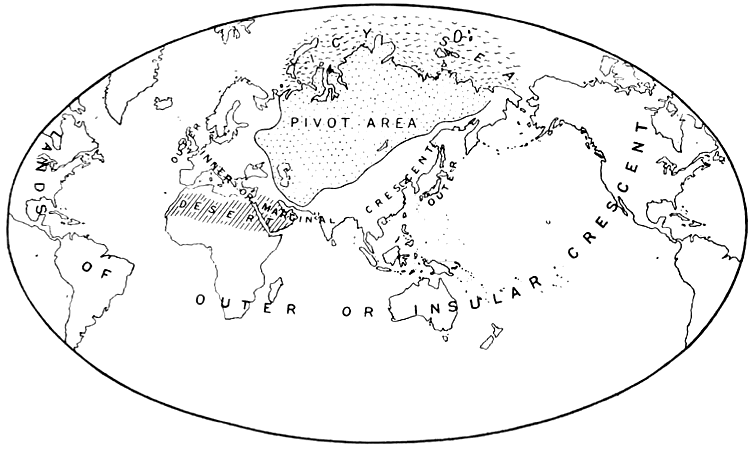
Considering the list of the most influential geopolitical thinkers of the past centuries, Halford Mackinder undoubtedly stands out as one of the most transformative figures in the field. His publication, titled the "The Geographical Pivot of History", which later was revised in the “Democratic Ideals and Reality”, known as the Heartland theory, might be decisive when evaluating today’s connectivity initiatives. In this article, we examine whether his statement “Who rules East Europe commands the Heartland, who rules the Heartland commands the World-Island, who rules the World-Island commands the world” still stands.
In Mackinder’s theory, the “pivot area” – later renamed the “Heartland” – was the central region of Eurasia, whose control could ultimately lead to world domination. Mackinder argued that in an era when the importance of traditionally dominant sea power was gradually declining, land power would become increasingly decisive. He believed that the Eurasian and African landmass – the so-called “World Island” – contained most of the world’s population, resources, and economic potential. Moreover, its inaccessibility by sea created a formidable defensive barrier. According to Mackinder, the region was vulnerable to land invasion only through the plains of Eastern Europe. Therefore, control over Eastern Europe would ensure domination of the Heartland and, ultimately, provide the foundation for global supremacy. In his later work, Democratic Ideals and Reality (1919), Mackinder revised and expanded the concept, renaming the pivot area the “Heartland” and extending its boundaries further westward, from the Black Sea to the Baltic region. However, Mackinder’s ideas were not without challengers. For instance, Alfred Thayer Mahan emphasized the importance of sea power, arguing that naval dominance and control over trade routes remained the key to global influence. Meanwhile, Nicholas Spykman reconsidered Mackinder’s Heartland theory by highlighting the strategic importance of the “Rimland” – the coastal regions surrounding Eurasia.
Anyhow, Mackinder lived in a period shaped by industrial competition, technological change, and shifting power balances. In many ways, it resembles today’s increasingly fragmented world, where competition over trade routes, energy resources, infrastructure, and spheres of influence is once again intensifying. Following Mackinder’s logic today, few regions illustrate the continuing relevance of the Heartland theory better than Central Asia. Situated at the core of Eurasia, the region has historically been at geopolitical crossroads where geography, connectivity, resources, and great power competition intersect. From the ancient Silk Roads to today’s emerging transport corridors, Central Asia has continuously linked East and West, while simultaneously serving as a buffer zone between competing empires and spheres of influence. We might confidently say that after the nineteenth century, the region is once again witnessing the emergence of a new Great Game, shaped by competing geopolitical, economic, and strategic interests.
After the collapse of the Soviet Union in 1991, the newly independent Central Asian republics – Kazakhstan, Uzbekistan, Turkmenistan, Kyrgyzstan, and Tajikistan – increasingly became arenas of geopolitical competition among external powers. While Russia has traditionally regarded the region as part of its historical sphere of influence, China has significantly expanded its presence through trade, infrastructure investments, and the Belt and Road Initiative. At the same time, the United States, the European Union, Türkiye, and several Gulf countries have also sought to strengthen their economic, political, and strategic engagement in the region.
Central Asia’s geopolitical importance today extends far beyond traditional security considerations. The region possesses substantial reserves of oil, natural gas, uranium, and various critical raw materials that are increasingly important for global industries and the green transition. Kazakhstan alone is among the world’s leading uranium producers and an important energy exporter, while Turkmenistan holds some of the world’s largest natural gas reserves. At the same time, the region’s geographic position has gained renewed importance as global powers seek alternative trade and transport routes amid growing geopolitical fragmentation and supply chain vulnerabilities.
Projects connected to the so-called Middle Corridor, the Trans-Caspian International Transport Route, and broader Eurasian connectivity initiatives increasingly position Central Asia not merely as a peripheral region, but as a strategic transit hub between Europe and Asia. In many ways, the region reflects the very dynamics Mackinder described more than a century ago: the enduring importance of geography, infrastructure, resources, and strategic access in shaping global power relations.
Author: Blanka Benkő-Kovács, advisor - LCTS, LUPS
Image source: Wikimedia Commons