The Role of Turks in the Iranian Modernization Process (19th-20th century) – part II-III
The first part is available here: The Role of Turks in the Iranian Modernization Process (19th-20th century) – part I
The Role of Turks in the Iranian Modernization Process (19th-20th century) – part II-III
Naser al-Din’s attempt to reduce the backwardness of Persia vis-à-vis the dominant powers failed, and in fact the country’s vulnerability actually increased. The use of capitulation, which is well known from Ottoman-Turkish history, naturally led to similar problems for the Persians, i.e. a reduction in the financial and political room for manoeuvre of the state. A good and understandable example of this was the case when, in 1872, Naser al-Din Shah sold to Paul Julius Reuter (1816-1899), the founder of the later news channel, a concession under which the Anglo-German business man was to have control of around 60% of the wealth generated by the mines, railways, tramways, dams and industrial installations being built in the country.[1]
At the same time, the advocates of Persian modernisation began to organise themselves independently of the ruler, setting up groups based in Istanbul and Cairo[2] and publishing Persian-language press products. Within the country, Tebriz became the intellectual centre of the change-makers, and the closest city to Baku, which was then part of Russia.[3]
As Iranian merchants were already present and represented in several cities under Ottoman rule, from Saloniki to Diyarbakır, from Trabzon to Basra and Damascus, they had accurate and first-hand knowledge of the Ottoman world of the time. What's more, in 1876 they had a Persian-language journal, and from 1883 Persian-maintained schools opened in the Ottoman Empire.[4]
Here we should mention the name of Mirza Hüseyin Han Sipehsalar (1828-1881), who spent all together eleven years in the Ottoman capital between 1858 and 1869. He was greatly influenced by Namık Kemal and Ali Suavi, and through his exchanges with Ottoman intellectuals he recognised that the reforms imposed on the Ottomans by the Western powers in Iran must be started before they were imposed by the great powers. He called for the building of railways, the integration of non-Muslims into the state apparatus and the establishment of new modern schools on the model of the Galatasaray Lyceum.[5]
Sipehsalar was also instrumental in the creation of the Cossack army. At the same time, the Russian-style military unit proved to be an excellent tool for the Tsar to increase his influence within the Persian state and to act as a deterrent to other British and American ambitions for Tehran through the Cossacks.
Cossack troops remained in the country until the victory of the Bolshevik Revolution. Their uninterrupted financial support was provided by the Shah, and their supplies – weapons, cannons and ammunition – by the Tsar.[6]
Mirza Yusuf Khan (1813–1895), from a merchant family in Tebriz, who held the post of Minister of Justice during the premiership of Siphsalar and who, in 1878, wrote his revolutionary ideas under the title of Yek Kelime, in which he initiated, among other things, the convergence of the French Constitution and Islamic teachings. In the same vein, Mirza Fethali Ahundzade (1812–1875), an Azerbaijani-born writer and director who embraced Persian culture, not only advocated the rapid adoption of Western models, but also called for a reduction of the influence of Islam on public life and, following the Ottoman intellectual debates of the time, for a change to a Cyrillic or Latin alphabet or a writing system more adapted to the sound system of Persian and Ottoman.[7]
The work of Mirza Malkom Han (1833–1908), who was of Armenian origin, also shows signs of Ottoman influence. He argued that the strengthening of central power and the creation of councils of ministers would not weaken the ruler's effectiveness, but actually increase it. He called for the establishment in Iran of an administrative and judicial forum along the lines of the Vâlâ-yı Ahkâm-ı Adliye of Meclis, established in 1838, which is well known from Ottoman history.[8] Malkom Han, who had studied in France as a child, returned to his homeland in 1851 to become one of the founders of the Masonic lodge of Ferámushane (فراموشخانه), established in 1857.
The main aim of the organisation was to cautiously modernise Iranian society, but they were careful in their activities. In 1862, however, Naser al-Din Shah banned the organisation, which was an excellent tool for increasing British influence, and even banished Malkom Khan from the capital, who was forced to settle in Baghdad. However, the Ottoman governor of Baghdad, Namik Pasha (1804-1892), took notice of Malkom Khan and helped him to Istanbul, where he was placed under the patronage of Siphsalar, who, as we have seen above, was then serving as a Persian diplomat in Constantinople.
Malkom Han lived in the Ottoman Empire until 1871, finding work and even marrying a Christian Armenian woman in 1864. On the occasion of the Christian wedding ceremony, Siphsalar asked Malkom Han, who presumably became a friend in time, the following poetic question: „I know you. You grew up as a Muslim and worshipped with Muslims in the mosque. Why did you decide to do that?”[9]
Malkom Han later returned to Tehran, only to travel from there to London shortly afterwards as an envoy, and later stareted to edit the Persian reformist newspaper called Kanun (قانون). During this period, he was of great assistance to the Shah during his aforementioned trips to Europe. Although he played a controversial role in the case of the rights sold out to Julius Reuters, for which he was temporarily disgraced in the eyes of the Shah, he once again represented his country at the Berlin Congress of 1878.[10]
It is also clear from the above that, although during the 19th century many Persian intellectuals and politicians who rose to important positions also recognized the need to adopt certain Western achievements, the ideas they formulated were less fertile than those of the Ottoman state and later the Turkish Republic. Even so, the intellectual influence of Tanzimat can in many cases be felt directly, particularly in the concepts and ideas of constitutionalism.[11]
Another important difference between Ottoman and Persian relations is that, in addition to developing cultural, educational and state organisation models, Istanbul, unlike Tehran, also took into account the economic policy aspects that were essential for state sovereignty. The development of Ottoman, and later Turkish-identified capitalist groups, as well as internal lending and the Ottoman banking system, contributed greatly to the Turkish state's later, post-World War I, ability to reduce its economic exposure and to embark on the path from semi-colonial to semi-peripheral status.[12]
Certainly, the fact that Ottoman modernization was backed by an elite with significant Balkan ties, which was not only culturally but also numerically integrated into the Turkish society in the Republican era, is also a significant aspect. The hundreds of thousands of people who moved from the Balkan nation-states to Anatolia or Eastern Rumelia in the second half of the 19th century can still have a lasting influence on the mentality and functioning of the state and society. In the case of Persia – if only because of its geographical location – there was no such intellectual stronghold, and influences from the West were able to take root in the wider society to a more limited extent.
According to C.E. Black, the Turkish and Iranian attempts at modernisation, which took shape, inter alia, during the constitutional period (1907–1911), followed a similar pattern until the rise to power of the Unity and Progress and the Young Turk movement, i.e. until 1908. The fundamental similarity was that in both countries the idea of modernisation was formulated primarily by the elite and not by the masses, and in both countries primarily because the autonomy of the state was seen as threatened.[13]
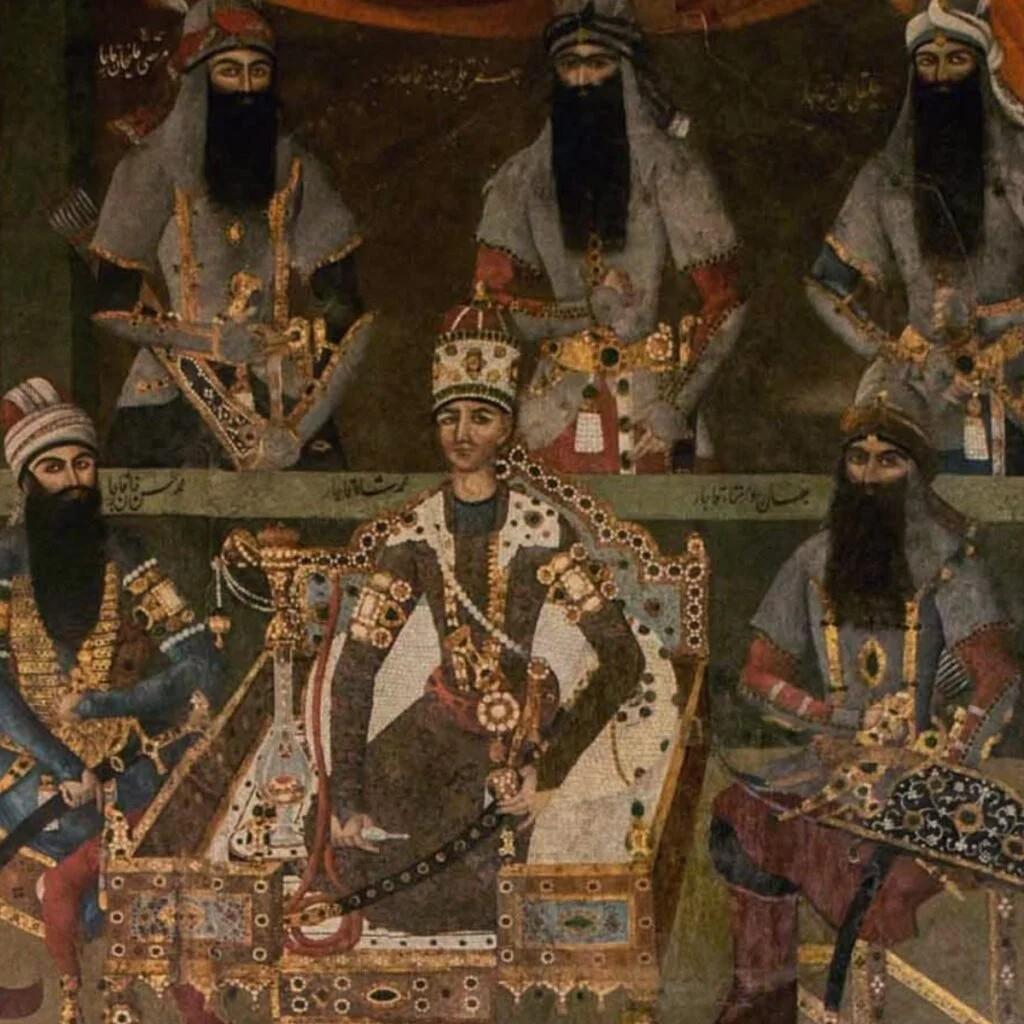
However, while after 1908 the Young Monarchs essentially took control of the state, in Iran the opposite process began, as after the promulgation of the 1907 constitution, the power of the central government was significantly reduced, and in fact, under the terms of the Russo-British cooperation, the two powers divided and controlled Persia along a north-south axis.[14] In this context, the country was part of the so-called ’Great Game’ between Britain and Tsarist Russia for control of Central Asia during the Khajar era.[15]
Although Mohammad Ali Shah had dissolved the Majlis, which had been convened a year earlier, in 1908, this could not offset the Russian intervention in 1911, which resulted in the accession of the last Khajar ruler, Ahmad Shah (1909-1925), and the temporary failure of the constitutional revolution. The relationship between the two societies and the political elites to reform is illustrated by the fact that while in the Ottoman case the Party of Unity and Progress (İttihad ve Terakki Cemiyeti) was able to defeat the counter-revolutionary forces within 10 days in 1909, in Iran it took the constitutionalist groups more than a year (16 July, 1909), and foreign (Russian and British) intervention was necessary.
1 Abrahamian, Ervand, Modern İran Tarihi. Çeviren: Dilek Şendil. Türkiye İş Bankası, İstanbul, 2020. 53.
[2] Cairo was also an important place for the Turkish nationalist intellectuals who opposed the Sultan, as it was here that Yusuf Akçura published his first work predicting the birth of Turkish nationalism, Üç Tarz-i Siyaset (Üç Tarz-i Siyaset) in 1904.
[3] Sárközy Miklós, Törzsek-nomadizmus-etnicitás, 298.
[4] Metin, Celal, Emperyalist Çağda Modernleşme. Türk Modernleşmesi ve İran (1800–1941). Ankara, 2011. 120.
[5] Metin, Celal, Emperyalist Çağda Modernleşme. Türk Modernleşmesi ve İran (1800–1941). Ankara, 2011. 124.
[6] Karadeniz, Yılmaz, Kacar İdaresi Döneminde İran’da Askeri Alanda Yapılan Islahatlar (1795–1925). In: Modern İran Tarihi Kacar Handedanı’ndan İsalm Devrimi’ne. Ed. by Osman Karacan. İstanbul, 2021. 106–108.
[7] Metin, Celal, Emperyalist Çağda Modernleşme. Türk Modernleşmesi ve İran (1800–1941). Ankara, 2011. 125–147.
[8] Metin, Celal, Emperyalist Çağda Modernleşme. Türk Modernleşmesi ve İran (1800–1941). Ankara, 2011. 142.
[9] „Seni bilirim. Müslüman dinine göre büyüdün ve Müslümanlarla birlikte camide namaz kıldın. Neden böyle bir karar aldın?” Devebakan, Mikail, Kaçar Dönemi İran Batılılaşma Öncülerinden Mirza Malkom Han Nazımü’d Devle (1833–1908). In: Modern İran Tarihi Kacar Handedanı’ndan İsalm Devrimi’ne. Ed. by Osman Karacan. İstanbul, 2021. 188–192.
[10] Devebakan, Mikail, Kaçar Dönemi İran Batılılaşma Öncülerinden Mirza Malkom Han Nazımü’d Devle (1833–1908). In: Modern İran Tarihi Kacar Handedanı’ndan İsalm Devrimi’ne. Ed. by Osman Karacan. İstanbul, 2021. 195.
[11] Sadeghi, Mohammad Hossein, The Ottoman Influence on Iran’s Constitutional Movement: A Reflection on Theoretical Foundations. In: The State Studies Quarterly Winter 2025, 10 (40). 36. https://tssq.atu.ac.ir/article_18766_5eb18aea91ccf2762de9f0abf89a822c.pdf?lang=en (latest download: 6 February, 2026.)
[12] See also Toprak, Zafer, İttihat-Terakki ve Cihan Harbi. Savaş Ekonomisi ve Türkiye’de Devletçilik 1914–1918. Kaynak Yayınları, İstanbul, 2016.
[13] Türkislamoğlu, Elif, Rıza Pehlevi Döneminde İran’da Modernleşme Hareketi ve bu Harekette Türk Devriminin İzleri. In: Atatürk Yolu Dergisi, 71 (2022). 324.
[14] Csirkés Ferenc Péter, Az iráni azeri-törökség. In: Kőrösi Csoma Sándor és Kelet népei. Budapest, 2005. 314.
[15] Abrahamian, Ervand, Modern İran Tarihi. Çeviren: Dilek Şendil. Türkiye İş Bankası, İstanbul, 2020. 50.
Author: Péter Kövecsi-Oláh, advisor - LCTS, LUPS
Image source: https://thelionandthesun.org/422/from-ashes-to-empire-how-the-qajar-dynasty-came-to-rule-iran/